January 30, 2005

Makyoh (Japanese magic mirror)-- Media Technology --

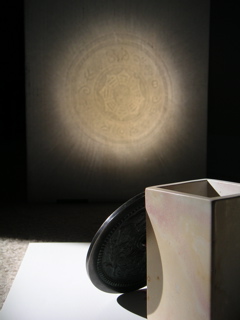
The Makyoh (Japanese for "magic mirror") is an ancient art that can be traced back to the Chinese Han Dynasty (206 BC — 24 AD). They were made of metal, usually with an intricate pattern carved or cast on the back and the front polished to a mirror finish. The front looks like a smooth reflecting surface, but when sunlight or other bright light is reflected onto a wall a glowing pattern emerges. Usually the image seen would be the same as the image on the back of the mirror, often an image of the Budah or other focus for meditation. The art later moved to Japan (especially Kyoto), and after missionaries brought Christianity into Japan in the mid 1500s many mirrors were made with secret images of the Holy Cross or of Christ. Because Christianity was punished at the time, many Christians wore such magic mirror as a secret sign of their faith.

I just received a modern makyoh from the Grand Illusions toy shop, a wonderful site for exotic, clever and scientific toys (and they now accept PayPal). One thing I love about Grand Illusions is that they include videos and articles about how their toys work, including the magic mirror. Much as I respect the secrecy magicians have for their tricks, I much prefer the magic scientists perform — real magic isn't spoiled when you know the secret, it's even more amazing.

I've posted a few other pictures on my pictures page.

Posted by bug to Media Technology at January 30, 2005 11:45 AM | TrackBack
Comments

this story is weird i didn't understand how it makes the pattern.

Posted by: Dane at November 17, 2005 6:19 PM

I own what may be a magic mirror - it looks just like on I saw on a show called "Ancient Technologies". I have just polished it but have yet to see the image. Are very similar mirrors made that are NOT magic mirrors? Mine is copper, 8" wide 7mm thick and has a Japanese landscape motief on one one side (2 cranes and a tree, etc.). Value? Age?

Posted by: James Morris at May 27, 2006 1:21 AM

There are mirrors that are similar that aren't magic mirrors, so if you can't get an image off of it then it might just not be magic. If using a flashlight, make sure it's far enough from the mirror that the light beam is roughly parallel. Sunlight works best I've found, but once I get it in focus even an image created by a flashlight is pretty clear with my mirror.

No clue what authentic makyoh's are worth - mine's a modern-day replica. I gather they were especially popular in 15th century Japan, but they've been around for thousands of years.

Posted by: Bug at May 28, 2006 9:53 PM

Could you please let me know where I could find a Japanese Magic Mirror with Christian symbols in the Boston area. We are very interested in purchasing a few.
Thank you!

Posted by: Susan Montgomery at June 14, 2006 9:09 PM

I suspect you'll have more luck looking online (especially Japanese sites), though if you do find a local place let me know!

Posted by: Bug at June 19, 2006 10:49 AM

I was given a magic mirror or medallion by a Japanese pastor when I visited Japan in 2003. Many people find it difficult to see the image and it can be seen by holding the polished side towards sunlight or a bright light, either hold it pointing towards a light wall or piece of white card (remember the Japanese would have held this towards a paper door or wall to see the image.) The mirror should be held approximately 30 or 40cm from the card or wall, it may take a little adjusting but the image will finally show.

I also have video of the the mirror being made today, the technique of making this mirror is maintained by the master mirror maker Yamamoto Kouryu who is a Intangible Cultural Asset this title being given by the Japanese government.

I am a Protestant, but have discovered the faith held by the Japanese Catholics of the 16th and 17th century to be an inspiration.

Posted by: Ken at November 8, 2006 9:08 AM

These mirrors work best if clamped to a photo tripod or similar, as it is very difficult to hand hold them still enough to get a sharp image on the paper. If reflected onto fine tracing paper pinned to a frame, the image can sometimes be viewed with transmitted light as well. This 'magic' effect can also can work with minted coins that have had one surface polished thin and smooth to a mirror finish, apparently the stamping process hardens the coin to different degrees depending on the design thickness, and the molecular structure of the metal is changed enough to reflect or refract light in different directions causing the image to appear. Some magic mirrors can also be viewed under polarised light it seems, and be easily photographed using polarising filters and a polarised light source. A few years ago whilst working as an art restorer, I amazed several collegues by demonstrating one of these mirrors using a small spotlamp as a light source. Although they had handled several mirrors before, they had no idea of their special properties! These mirors often appear cheaply at flea markets and if tarnished can be carefully polished back to useable condition with a little work. I have also had a punch decorated Islamic plate made from copper, that demonstrated this phenomema with light reflected from the reverse surface, and I am sure there must be other common polished items which will work too.

Posted by: Ken at June 28, 2007 7:11 AM
Post a comment


Anonymous posting is allowed, as are these HTML tags — a href, b, br, p, strong, em, ul, li, blockquote.
Email addresses are spam-protected.

You must have Javascript enabled to comment, due to the code I'm using to try to outwit spammers. Sorry for any inconvenience this may cause.

Remember Me