Semapedia is a project to annotate physical locations with 2D barcodes that link to Wikipedia articles. With the Semacode software running on your PDA/cellphone, you scan a barcode and it’ll take you to the linked-to article. There’ve been a lot of attempts at this sort of physical annotation of the world, WorldBoard being one of the earlier ones I remember.
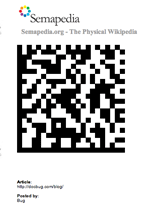
I like the concept in theory, but I’m always disappointed by the quality and variability of the links. Do I really want a link about privacy just because I see a no-tresspassing sign, or about the Hofburg Imperial Palace just because I’m standing there? Perhaps, if I’m in the mood for ironic social commentary or I’m a tourist with an interest in architecture, but most people won’t be the right audience for any given link. One man’s art is another man’s graffiti, and the world-annotation systems I’ve seen are currently little more than virtual spray paint.
The variability is the real key. If 90% of the tags I come across link to something interesting to me, I’ll probably follow every one I see. If only 50% link to something interesting, I might look at the human-readable title printed on the tag and then decide whether I think it likely that the article will be well-written and interest me. If 90% of the tags wind up being useless, I won’t even bother reading the title — and then it won’t matter that there are 10% that I would have enjoyed if I had bothered to look.
I’m not totally pessimistic about this sort of technology though. With the right combination of filtering (to make tags I don’t care about completely invisible), subtlety (to make the tags I might care about still be unobtrusive in case I don’t want to be bothered) and community support (to insure relevance to me and to bond me to my community regardless of the link quality), I could see something like this finally taking off.
(Thanks to Eugen Leitl on the Wearables mailing list for the link!)