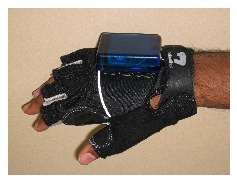
The winner of this year’s best paper award at ISWC (the first ISWC to have such an award) was a paper by Don Patterson from the University of Washington called Fine-Grained Activity Recognition by Aggregating Abstract Object Usage. All the authors got certificates and Don took home a new video iPod as the prize.
This was one of several papers presented that used an RFID reader in a glove, in this case to classify what kind of activity a person is conducting based on the sequence of objects she has touched. This would be useful, for example, for alerting a care worker if a resident of an assistive-living home had stopped eating.
From the abstract:
In this paper we present results related to achieving fine-grained activity recognition for context-aware computing applications. We examine the advantages and challenges of reasoning with globally unique object instances detected by an RFID glove. We present a sequence of increasingly powerful probabilistic graphical models for activity recognition. We show the advantages of adding additional complexity and conclude with a model that can reason tractably about aggregated object instances and gracefully generalizes from object instances to their classes by using abstraction smoothing. We apply these models to data collected from a morning household routine.
Here are all six nominees for best paper from ISWC’05, which were the top 10% of full papers based on reviewer-rating:
-
Fine-Grained Activity Recognition by Aggregating Abstract Object Usage (author’s PDF), by Donald Patterson, Dieter Fox, Henry Kautz, Matthai Philipose (U. Washington and Intel Research, Seattle)
-
ReachMedia: On-the-move interaction with everyday objects (author’s PDF), by Assaf Feldman, Emmanuel Munguia Tapia, Sajid Sadi, Pattie Maes and Chris Schmandt (MIT Media Lab)
-
A Design Process for the Development of Innovative Smart Clothing that Addresses End-User Needs from Technical, Functional, Aesthetic and Cultural View Points by Jane McCann, Richard Hurford and Adam Martin (University of Wales)
-
Pictorial Depth Cues for Outdoor Augmented Reality by Jason Wither and Tobias Höllerer (University of California, Santa Barbara)
-
A Body-mounted Camera System for Capturing User-view Images without Head- mounted Camera by Hirotake Yamazoe, Akira Utsumi and Kenichi Hosaka (ATR)
-
The Impacts of Limited Visual Feedback on Mobile Text Entry for the Twiddler and Mini-QWERTY Keyboard (author’s PDF) by James Clawson, Kent Lyons, Thad Starner and Edward Clarkson (Georgia Tech)