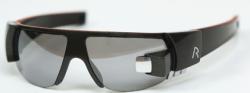
Sunglasses company Rodenstock presented Informance, a "design study for the spectacles of the future" at this year's OPTI trade fair in Munich. Made in conjunction with UK-based Cambridge Consultants, these are a pair of sunglasses with a 160 x 120 pixel head-up-display embedded in the glasses. The design looks similar to the prism-in-glasses approach that MicroOptical (now Myvu) did about 10 years ago.
One of the big problems with the old in-glasses-style MicroOpticals was that the field-of-view was small enough that you really needed a custom fit to put the display in the right location, and even then it was hard to use when walking or running. MicroOptical's display was at the center rather than the edge of the glasses, which may make a difference — given that Rodenstock intends athletes to use this to see heart-rate, time, etc., I certainly hope so.
(via NewScientistTech via engadget via Fairyshaman)
Posted by bug to Wearable Computing at October 19, 2007 11:07 AM | TrackBackThe company I'm really watching for the ultimate heads-up display is Lumus ( http://lumusvision.com ). They're using the same sort of trick as Microoptical to use the interior of the eyeglasses as an optical path, but rather than a mirror in front of the eye, there's an array of microprisms on the inner surface.
This allows them to basically take advantage of internal reflections and fold the optical path so that the field of view isn't restricted by the thickness of the glasses. They had an example running at a SID conference I attended a couple of years ago, and it definitely works: a see-through display with a field of view comparable to a desktop monitor (they're quoting like 30 degrees).
Now if only they can get to market...
Posted by: Edward Keyes at October 24, 2007 7:42 AMI wonder which applications one could prove worked better with this style of wearable.
I remember, many years ago, when a survey of wearable papers showed that only a few measured the work performance of wearables, and only one, helicopter repair, showed an increase in performance.
Haven't you noticed that people drive slower when talking on cell phones?